
Newsletter

  • Central Comprehensive Center September 2026 Quarterly Highlights

    Central Comprehensive Center September 2026 Quarterly Highlights

    Celebrating Connection and Regional Collaboration

    Last month, the Central Comprehensive Center (Central CC) Advisory Board met in Denver. It was great to bring people together for a day of sharing, learning, and idea generation. Representatives from all seven states—Colorado, Kansas, Missouri, Nebraska, North Dakota, South Dakota, and Wyoming—attended.

    Our Advisory Board is critical to guiding our work. We rely on their perspectives and feedback to help ensure our technical assistance is responsive, relevant, and aligned with regional needs. During the meeting, we engaged in a thoughtful discussion about the Central CC’s services, focusing on strengths, opportunities, and ways to best support states’ evolving needs. These conversations provided valuable perspectives that will help inform our ongoing work.

    Board members emphasized the importance of delivering evidence-informed support, remaining adaptable to state contexts, and recognizing the time demands facing education leaders and practitioners. In addition, members learned more about projects across the region, creating opportunities to connect around shared needs, challenges, and learning opportunities. Discussions highlighted common areas of focus, including chronic absenteeism, literacy, and mathematics.

    Stay tuned for more resources from these projects. In the meantime, below you will find project share-outs from Kansas and Wyoming, as well as our continuing work on assessments.

    If you have any thoughts about our services, send us an email. We’d love to hear from you.


    Resource Recap

    Read about Kansas’ cross-agency partnership, Wyoming’s process for supporting districts with resource allocation reviews, and accountability assessment considerations in our most recent blog posts.


    Highlighting Our Work

    Improving outcomes for students means strengthening the systems, policies, and people behind them. Members of our Central CC team share insights about our projects and work in this video, created by NORC at the University of Chicago.
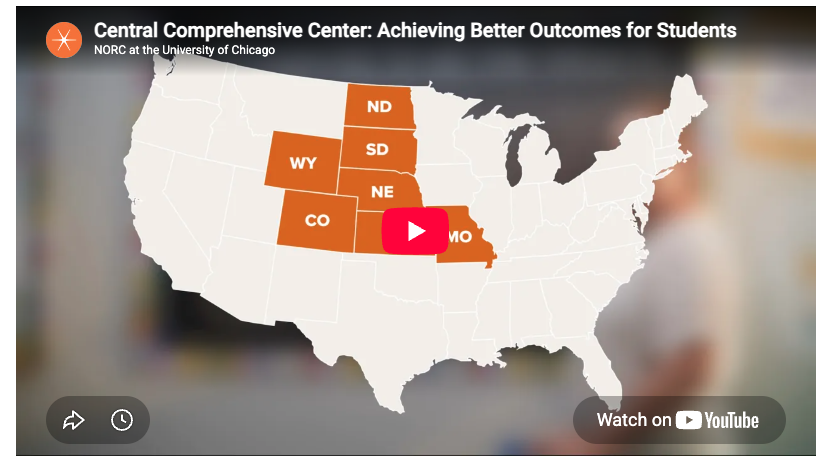
    Frame from video showing Central region map

    To learn more about NORC and NORC’s work within the education field, sign up for their education newsletter here.


    In Case You Missed It …

    Here are a few additional Central CC resources we’ve shared recently.

    > Exploring Within-Year Assessments

    > Report: Considerations for Assessment Flexibility Approaches

    > Brief: Innovation in Assessment and Accountability Systems


    We are grateful for your time and support. Please stay in touch and be part of the conversation. We’ll also be sharing updates regularly here on the blog and on our LinkedIn page. If there’s a topic you’d like to hear more about, reach out and let us know!


    Sign Up Now

  • Central Comprehensive Center June 2026 Quarterly Highlights

    Central Comprehensive Center June 2026 Quarterly Highlights

    Our Work Reflects National Report Themes

    The summer months have been full steam ahead across the Central Comprehensive Center region. As our teams continue supporting state education agencies (SEAs) in our region, we took special note of the National Assessment of Educational Progress Long-Term Trends report released in mid-June. 

    In a cause for celebration, average scores for 9-year-olds increased in both reading and math between 2022 and 2025, bringing them back in line with pre-pandemic scores. Notably, scores increased among the lower performers at the 10th and 25th percentiles. 

    Reading the subsequent new stories about the results, we couldn’t help but see parallels between the report’s themes and the work our state partners are focusing on, including:

    • Early literacy and mathematic instruction matters. The 9-year-olds were not yet in kindergarten when pandemic-related shutdowns disrupted learning for students. 
    • Being present is critical. Student absenteeism continues to be a challenge, especially for the 13-year-old cohort, whose test scores remained stagnant.
    • Targeted support can make an impact. Additional federal education funding from the pandemic often went to student subgroups that saw some of the biggest improvements in test results.

    While the results tell us there’s still more work to be done for academic recovery, it also tells us the work our SEAs are doing is making a difference.


    Resource Recap

    Over the past quarter, we launched our blog. We started with a few posts exploring a question many SEAs are asking: Is it time to rethink how we test our students? Check out our first posts and follow along as we explore this complex and evolving topic.

    Innovating State Assessments: Getting It All RightRecipes for Success: Crafting an Effective State Assessment System

    Highlighting Our Work

    As part of our work on comprehensive assessment systems, we’ve created a carousel exploring elements of four common within-year assessments: interim, through-course, focused, and diagnostic. Below is a sneak peek at one of the slides. 

    Check out the carousel and more news on our LinkedIn page!


    We are grateful for your time and support. Please stay in touch and be part of the conversation. We’ll also be sharing updates regularly here on the blog and on our LinkedIn page. If there’s a topic you’d like to hear more about, reach out and let us know!


    Sign Up Now

  • Introducing the Central CC Newsletter

    Introducing the Central CC Newsletter

    The Central Comprehensive Center has launched a quarterly newsletter, and the first issue is out now.

    Each quarter, we’ll share highlights from our work with state education agencies across Colorado, Kansas, Missouri, Nebraska, North Dakota, South Dakota, and Wyoming. You can expect project updates, new resources, and news from across the region.

    Central Region: 1,898 School Districts, 8,444 Schools, 2,933,197 Students

    Our work focuses on four areas that state education agency teams have identified as priorities: improving literacy and math instruction, developing the educator workforce, supporting rural and Tribal education, and strengthening state education agency processes. The newsletter is a way to keep you connected to that work as it develops.

    The inaugural issue introduces our mission, highlights the scope of the Central Region (1,898 districts, 8,444 schools, and nearly 3 million students), and shares our first two published resources.

    Sign Up Now

    We’ll also be sharing updates regularly here on the blog and on our LinkedIn page. If there’s a topic you’d like to hear more about, reach out and let us know!