
By Robert Meyer and Claudia Gentile
States, districts, and schools know that having high-quality data can be a game changer. Accurate data is used to pinpoint areas for improvement and showcase areas of success. It can help administrators amplify a message and build a coalition of understanding and support. Policies, priorities, and projections often are based on data collected from state assessment systems.
Therefore, schools, districts, and state educational agencies need assessment systems that serve multiple purposes, such as:
- providing valid and reliable measures of student achievement and growth for accountability;
- supporting educators with timely information for instruction; and
- offering diagnostic insight for struggling learners.
States often hope to satisfy these objectives without increasing test burden, which is a challenge—assessments designed for accountability need to be standardized, broad in scope, and precise; while instructionally focused assessments need to be flexible, targeted, and fast. However, just like anything in life, when one assessment is asked to do too much, it can miss the mark entirely.
Fortunately, it is possible to design an assessment system that serves multiple purposes by including different types of assessments, some primarily designed to support accountability and some primarily designed to support instruction. It is also possible to reduce test burden by more efficiently combining data from different assessments, especially when measuring student growth, a topic we will discuss in a later blog post.
Known as a comprehensive assessment system, this system is crafted to include different types of assessments to address different needs.
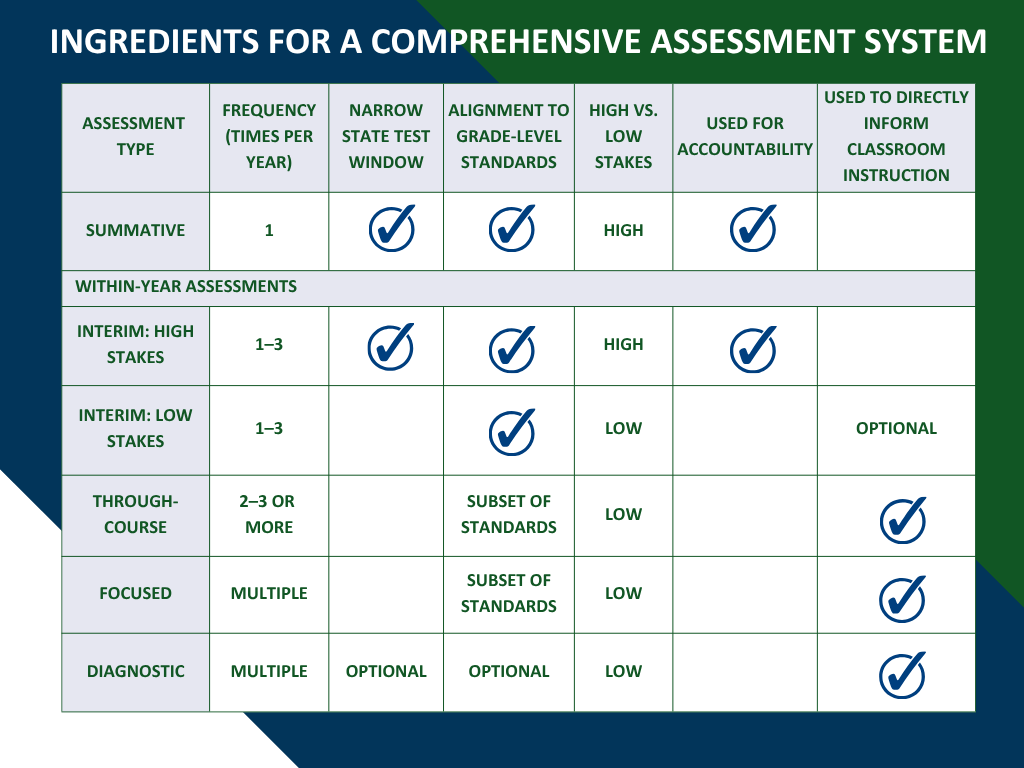
Ingredients for a Comprehensive Assessment System
Similar to a recipe with the ingredients carefully curated, creating a state comprehensive assessment system requires a combination of assessments to produce the right balance. These state systems often feature summative and within-year assessments, including assessments to address any specific needs or gaps.
Summative Assessments
End-of-year summative assessments are administered once a year. These comprehensive tests are required and considered high-stakes, aligned to grade-level standards. They are administered in narrow windows to ensure comparability between students and schools. They anchor the assessment system by measuring the knowledge acquired during and persisting to the end of the school year.
Summative assessments are used to construct two key accountability metrics: student- and school-level proficiency and growth. Summative assessments also can be used in program evaluations and in early warning systems. (At the high school level, where some subjects are administered in half- and full-year modules, some summative assessments are end-of-course tests.)
Within-Year Assessments
Interim assessments are administered one or more times during the year (typically fall, winter, and spring). They provide a way for educators to update information about students’ achievement and progress. Interim assessments are usually aligned to grade-level standards. They may or may not be measured on the same scale as summative assessments and may or may not be administered in narrow testing windows. Interim assessments generally contain fewer items than summative assessments.
As we will discuss in a later blog post, improved growth measures may be constructed using summative and interim assessments. In this accountability application, the interim assessment acts as a high-stakes assessment. One of the potential advantages of this approach is that it could allow both the summative and interim assessment to be shorter, yet capable of producing reliable accountability measures.
Other within-year assessments are designed to provide direct instructional support and thus are best designed as low-stakes examinations. They can be administered in flexible testing windows and typically cover selected learning standards.
Focused assessments can be administered many times during the school year. They are flexible, short assessments focused on subsets of standards used to inform classroom instruction.
Through-course assessments may be administered 2–3 times during the school year or more frequently. These assessments test subsets of standards across several administrations and typically are not administered in narrow testing windows.
Diagnostic assessments are administered at specific times during the school year to inform selection into programs for low-performing students and to identify student strengths and areas for improvement prior to instruction.
The first step to any assessment overhaul is reviewing your assessment system recipe to examine how it supports the multiple objectives of a comprehensive assessment system. Our next blog in this series will explore how to improve the assessments already in use.
The Central Comprehensive Center continues to work with state education agencies, educators and researchers to develop approaches to improving state assessment systems, both the quality and usefulness of assessment data for all stakeholders. Through requests from our states, we’re diving into the opportunities for innovation within state assessment systems and highlighting our findings in a series of blog posts.